Keep what matters.
tYPE
UX Design · UI Design · Research
ROLE
Lead Product Designer
pLATFORM
Cross-platform (Web, iOS, Android)
TOOLS
Figma · FigJam · UserZoom · Google Analytics
The Context
Lost in the Queue
In 2025, The Daily Telegraph’s readers were highly engaged but digitally overwhelmed. Our data showed a "leaky bucket" in the user journey: thousands of articles were being "saved," but few were ever being reopened. For a premium subscription business, this was a missed opportunity for habit formation. I was tasked with redesigning the save-and-retrieval experience to ensure our journalism didn't just get bookmarked, but actually got read.
The Challange
Turning "Digital Hoarding" into a Reading Ritual
A utility masquerading as a feature.
Saving an article is a simple action. What happens next is not. We were designing against a well-documented psychological pattern the relief of saving something displaces the intention to read it. The article gets filed. The guilt gets quieted. The reading never happens.
We set three goals. Make saving frictionless. Make retrieval visible. Turn a one-tap utility into a habit readers actually formed.
My Role
The lone voice for the reader in a room full of stakeholders.
I led the UX end-to-end from early research through to engineering handoff. I worked alongside a Product Manager to define what success looked like, and a Copywriter to ensure every prompt felt like an editorial nudge rather than a product push. Every decision came back to a single question: what does the reader actually need here?
Discovery & Insights
Beyond the Button
I observed 15 readers in the places they actually read on commutes, in coffee queues, at home on weekend evenings. I wasn't watching whether they could find the save button. I was watching when they reached for it, and what happened next.
What I found reframed everything.
85% of saves happened on mobile, in short windows of stolen time. But readers expected to come back to those articles on evenings and weekends, in longer, more deliberate sessions. The UI treated both moments as the same. They weren't.
The bigger problem wasn't the save rate. It was what happened after. Users told us directly: "I save things, but I have no idea where they go." There was no confirmation. No sense of place. The act of saving felt like dropping something into a void.
The insight that changed the project: we weren't building a bookmarking tool. We were building a read-later service. Those are fundamentally different design problems.

Reframing The Problem
Moving from a checkbox to a gateway
The Telegraph treated saving as the end of a session. I reframed it as the beginning of the next one. The question shifted from "how do we make saving easier?" to "how might we transform the save action from a terminal point into a gateway for the reader's next session?"
Storage model out. Queue model in.
The Design Solution
Fast enough to save in the moment. Clear enough to find it when it matters.
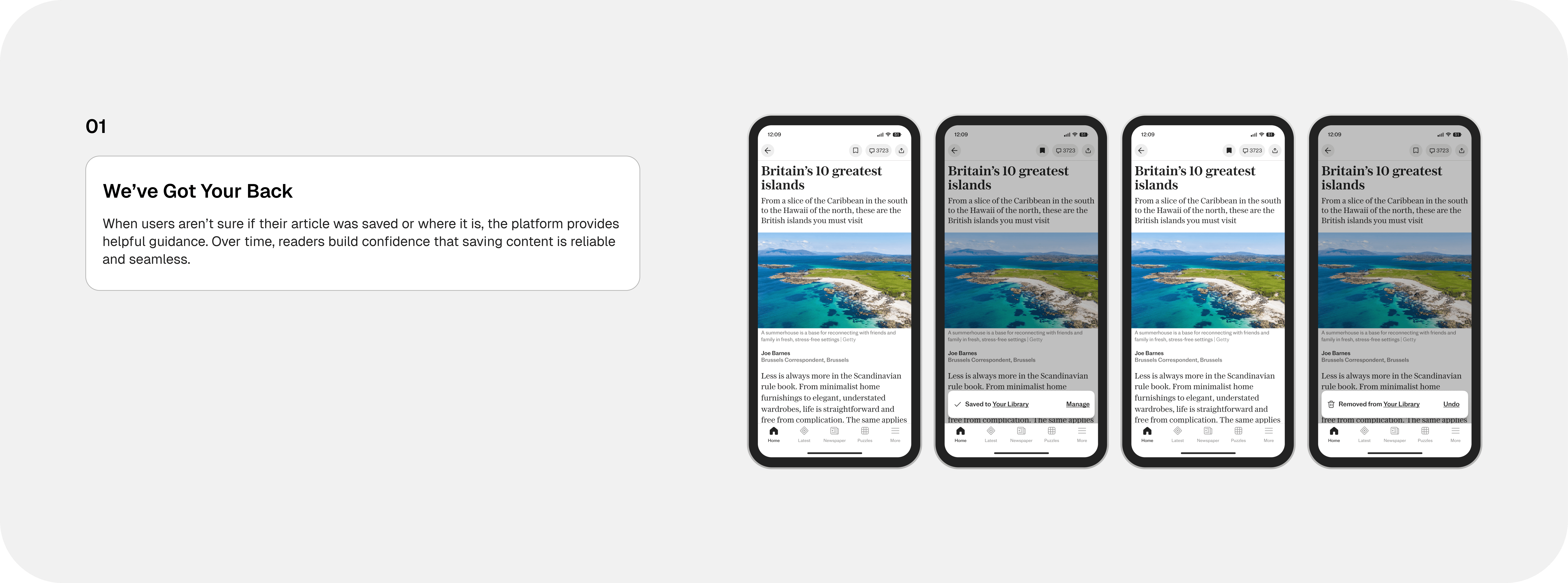
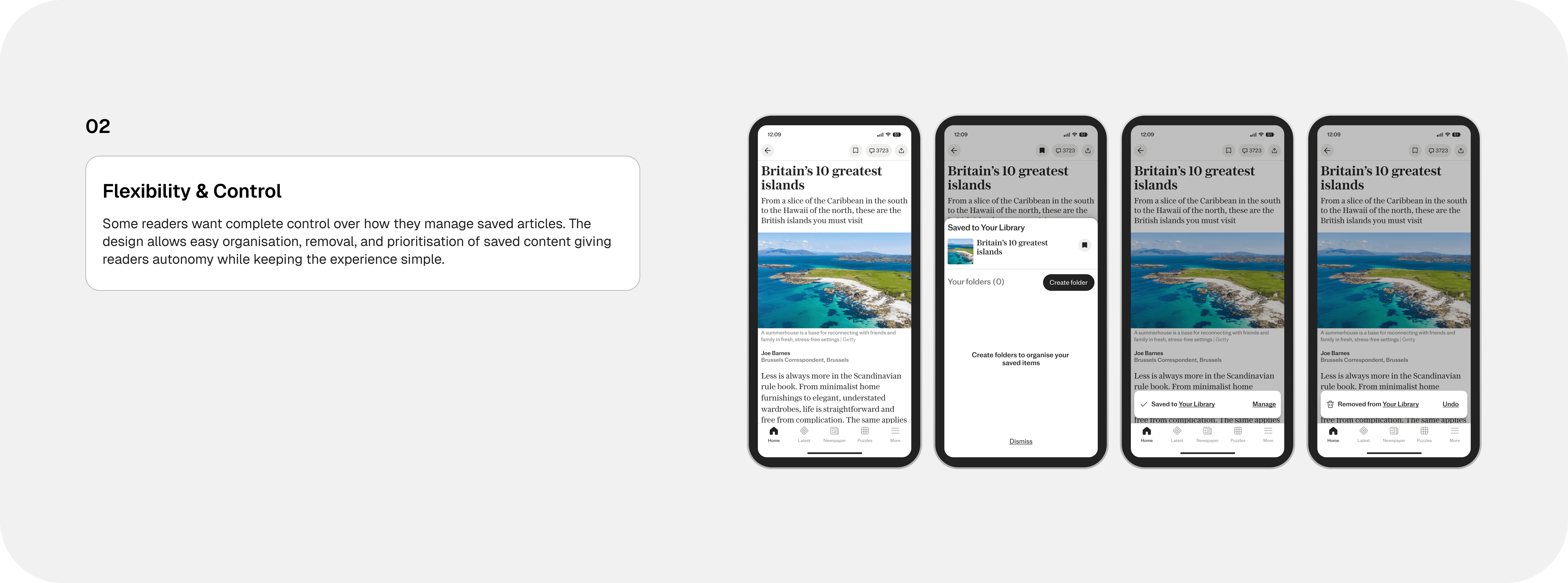
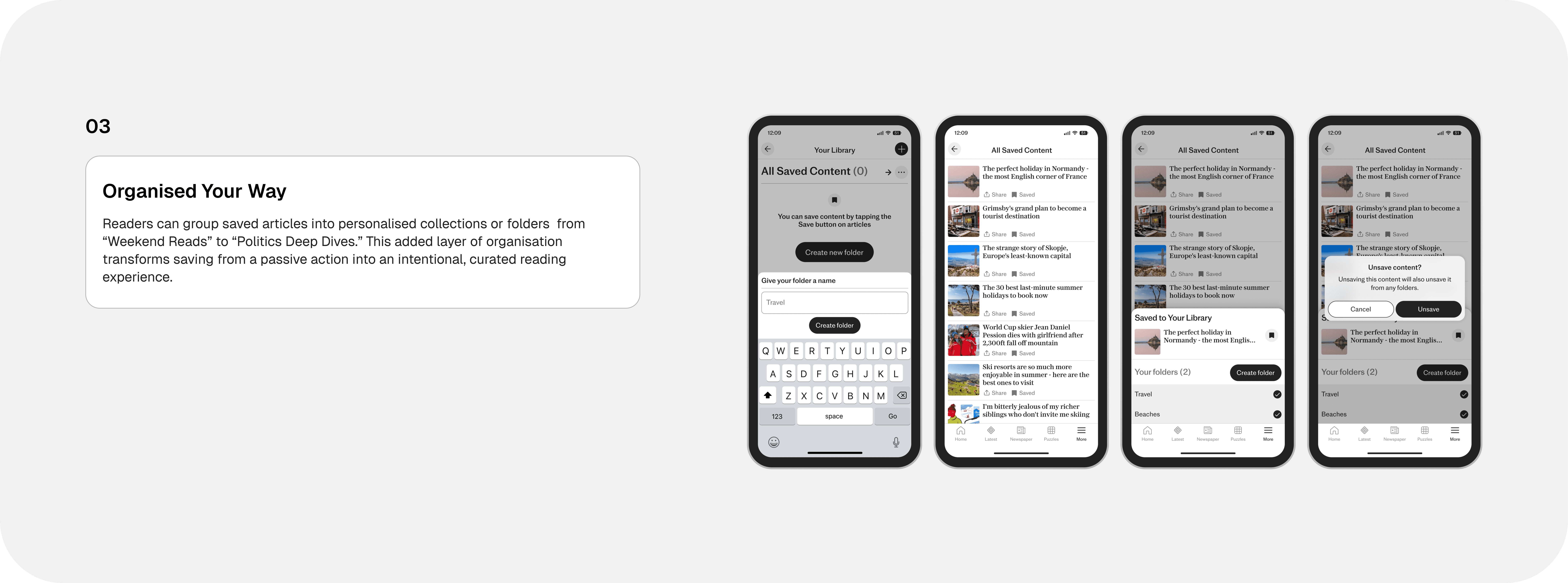
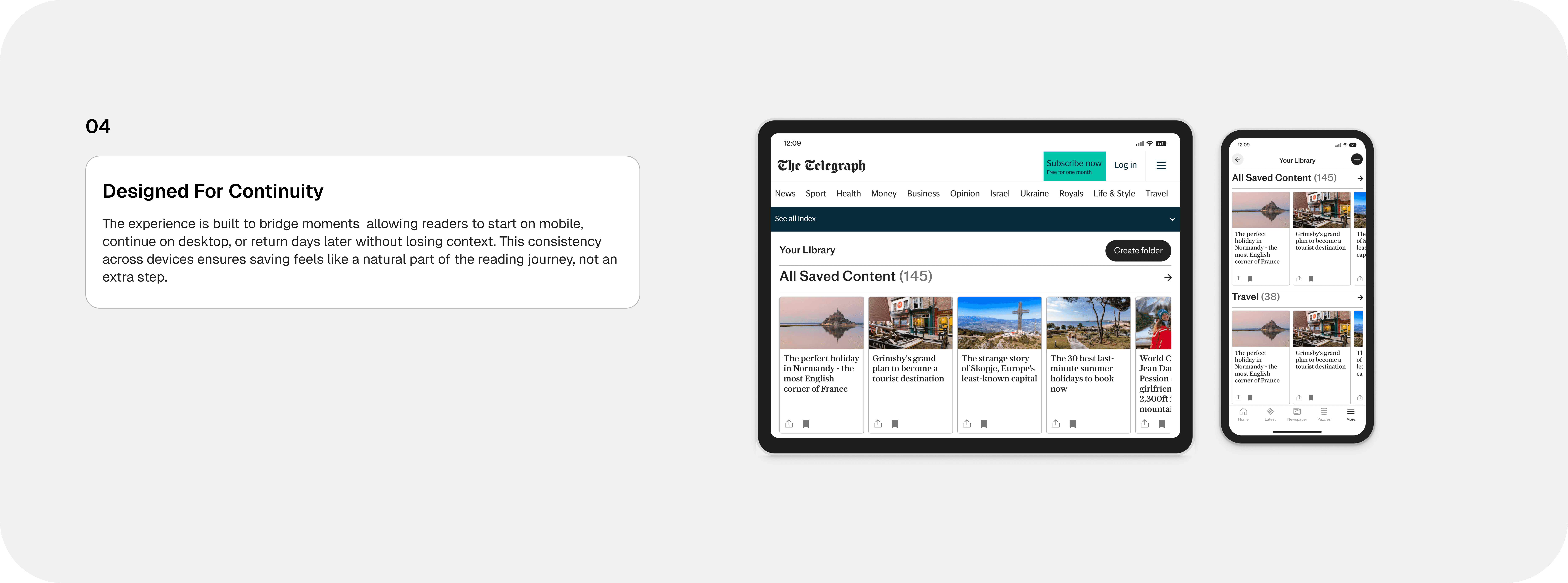
In an age where everything is competing for readers’ attention, The Telegraph helps readers reclaim their time by making saving articles fast, effortless, and intuitive. The platform makes sensible decisions for users, offering guidance in ways that are clear, understandable, and actionable.
How We Got Here
Visual anchors outperform chronological lists
I used a Working Backwards framework to map friction across the full save-and-retrieval journey. Three questions guided the design:
How do we trigger saving without interrupting reading? Early wireframes used a persistent, high-contrast save button. Testing killed it readers described it as "too commercial." The solution was a contextual trigger: the button surfaces subtly once a reader passes 50% scroll depth, signalling genuine intent to finish the piece later. Visible when it matters. Invisible when it doesn't.
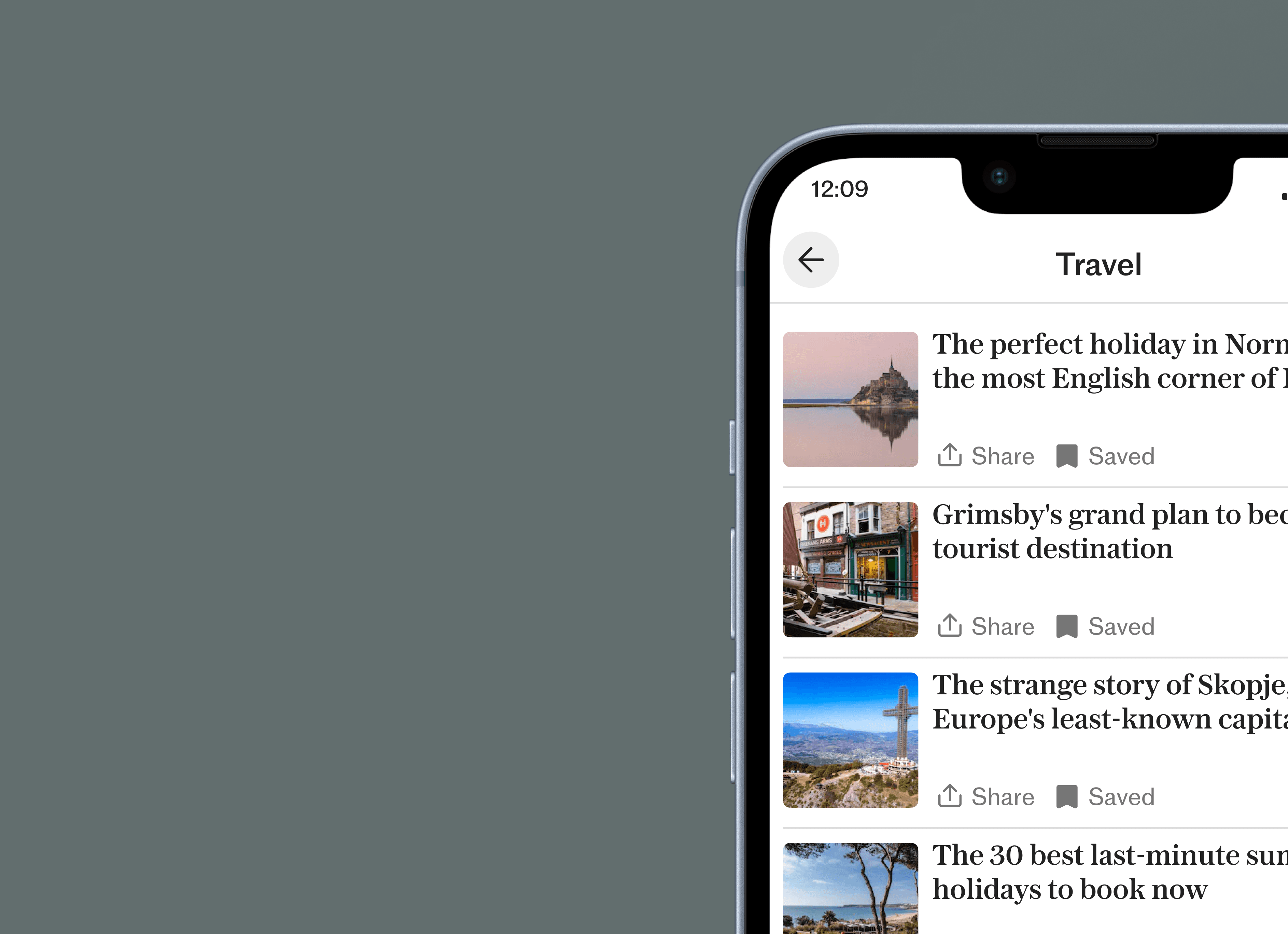
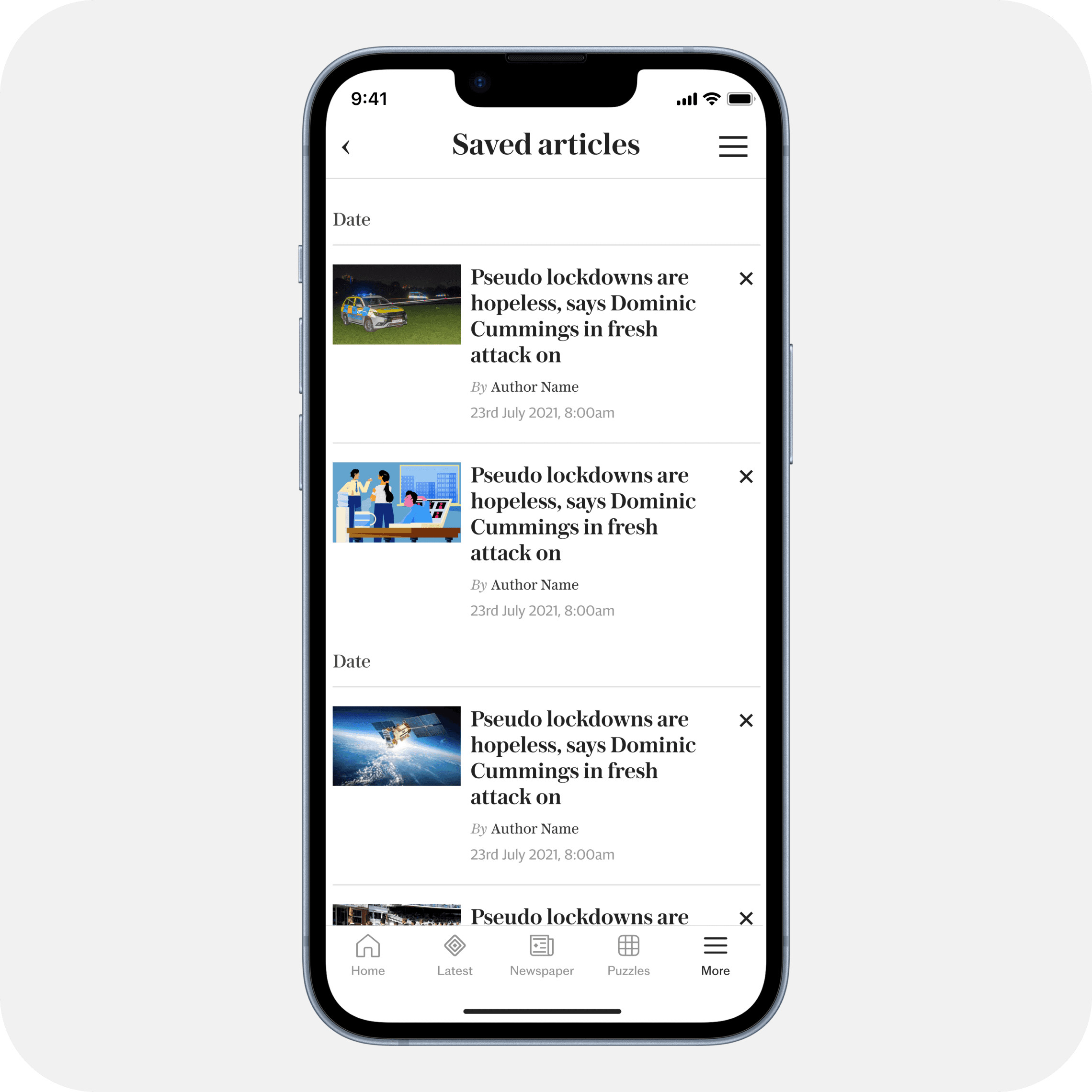
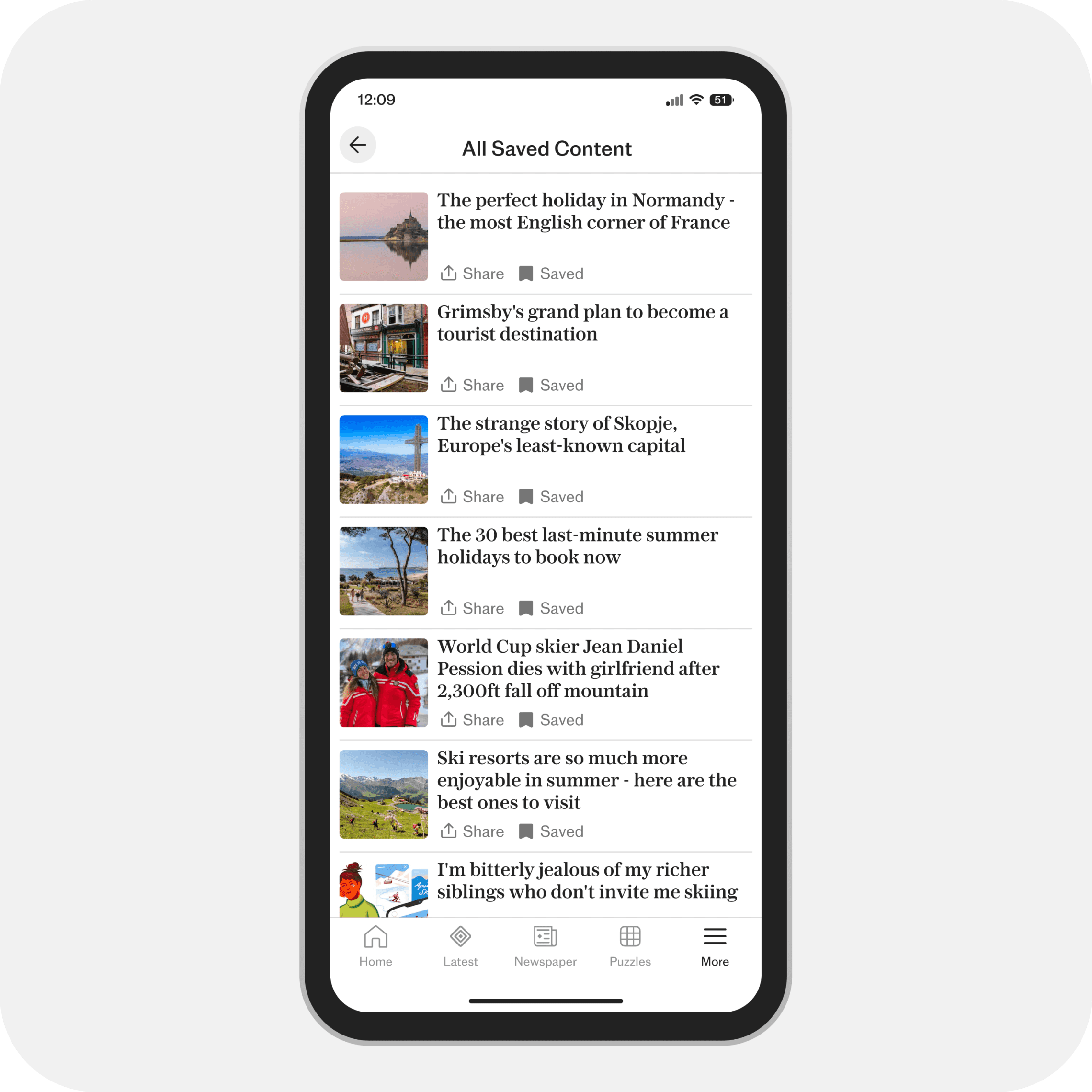
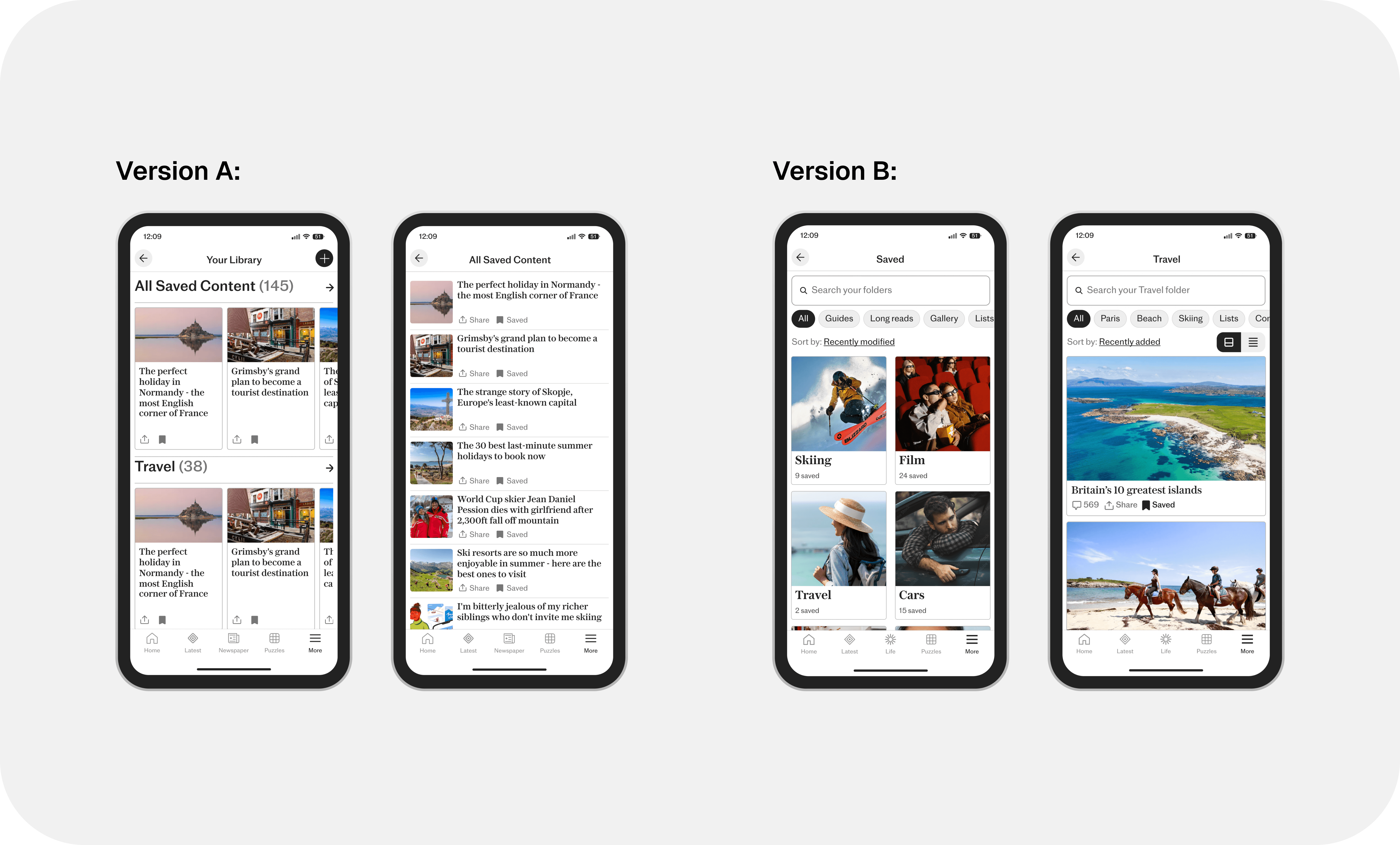
How do we make saved articles feel worth returning to? I tested two versions of the Saved Articles hub. Version A was a chronological text list. Version B was a card-based, image-led layout the same visual weight as the Telegraph front page. Version A won decisively. Readers navigate by headline, not image. Treating saved articles with the same prestige as new ones changed how readers perceived the value of what they'd kept.
How does language shape behaviour? Working with our Copywriter, we replaced "Add to Bookmarks" with "Save for Later." Two words. The shift in tense implies a future action it plants the intention rather than just recording the action.
The Impact
A major driver for subscriber engagement
Launched as a pilot, the redesign transformed the feature from a niche tool to a major engagement driver:
+31% intent-driven save rate
+19% return visits to Saved hub
+24% long-form article completion
+11% next-session open rate from saved articles
Reflections & Insights
Designing for human psychology, not just UI
The save button had always been there. What was missing was everything around it the confidence that saving meant something, the visibility to make retrieval feel possible, the language that made the habit feel natural. Success here wasn't measured in saves. It was measured in reads.
Next Steps:
Next: offline caching for underground commutes. Smart NLP categorisation to turn a growing queue into an organised reading list.